


Digital Signage vs Vinyl Printing: Which Is Better for Your Business?



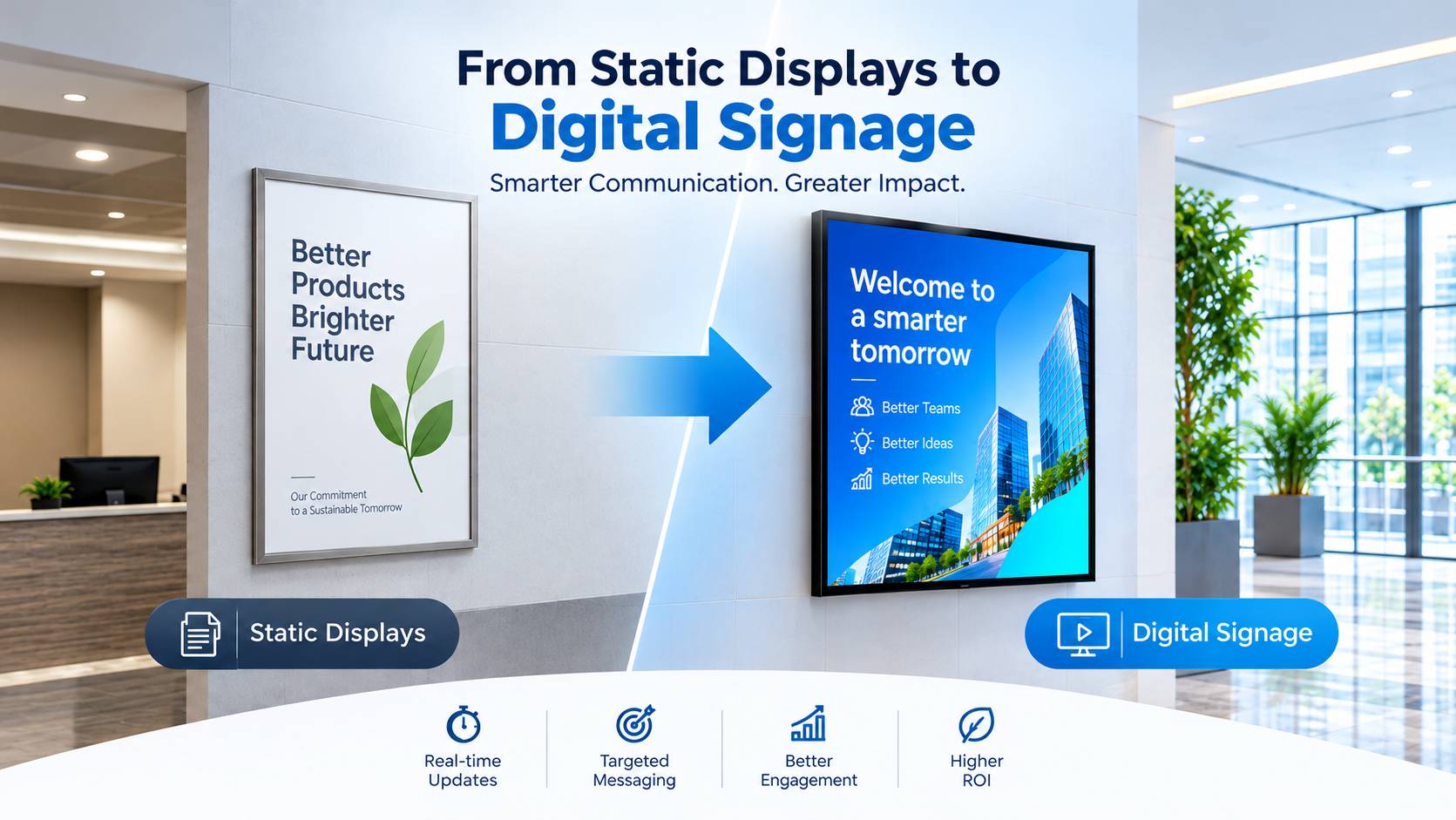
Businesses use visual displays to promote products, communicate offers, and maintain brand visibility. Vinyl printing has traditionally been used for storefront graphics, promotional posters, menu boards, and in-store branding. However, when campaigns change frequently or need to be managed across multiple locations, printed materials can require repeated production, delivery, and installation.
Digital signage is generally better for frequently changing content, scheduled promotions, and multi-location communication. Vinyl printing is often more suitable for fixed branding and messages that rarely change. For many businesses, combining both formats is the most practical approach.
The right choice depends on your communication needs, update frequency, number of locations, and total operating costs.
What Is the Difference Between Digital Signage and Vinyl Printing?
Digital signage uses electronic displays to show content such as images, videos, promotions, menus, dashboards, and announcements. With compatible digital signage software, businesses can schedule content, update messages remotely, and manage connected screens through a central platform.
Vinyl printing uses printed graphics applied to windows, walls, signboards, and other surfaces. The displayed message usually remains unchanged until the material is replaced or updated physically.
The fundamental difference is how businesses manage and update their communication.
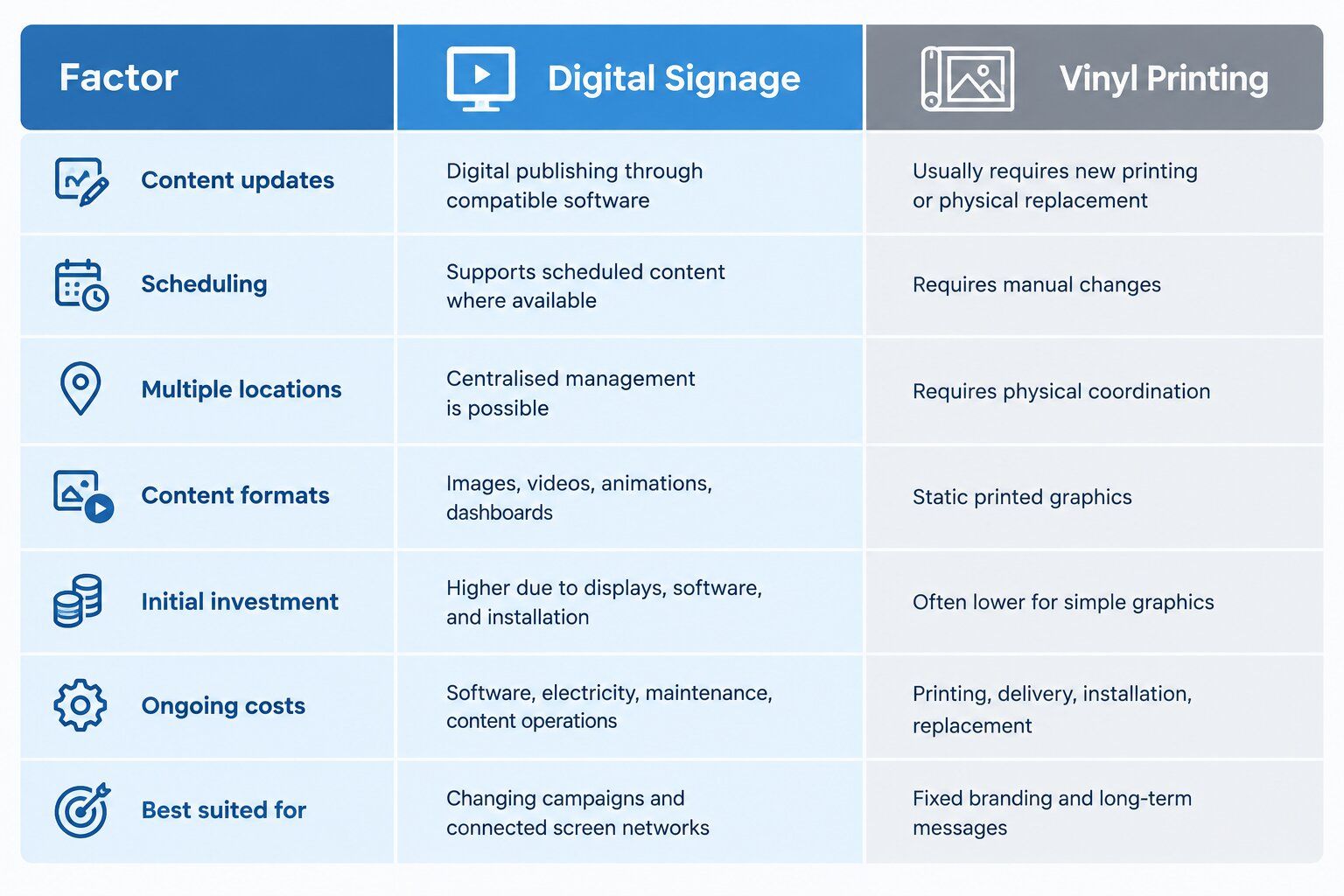
Digital signage offers greater flexibility, but it also requires hardware and ongoing management. Vinyl printing is simpler for many fixed applications. Neither format is automatically the better investment in every situation.
5 Key Differences That Matter to Businesses
1. Content Updates and Campaign Flexibility
With vinyl printing, changing a promotion may involve preparing new artwork, printing it, delivering it to the location, and replacing the existing material. This process may be straightforward for occasional updates but becomes more involved when campaigns change frequently.
Digital signage allows authorised users to publish revised content through compatible software without replacing the display. Businesses can update prices, promote new products, schedule seasonal campaigns, and change announcements remotely, depending on their system and connectivity.
For example, a retail store can replace a weekend offer with a new promotion digitally rather than printing and installing a fresh graphic.
Business impact: Digital signage is particularly useful when the cost and coordination involved in repeated physical updates become significant.
2. Multi-Location Communication
Businesses operating several branches need to maintain consistent branding while adapting messages to local requirements.
Printed campaigns may require separate coordination for production, delivery, installation, and removal. Digital signage software can centralise publishing across connected screens, allowing teams to distribute common campaigns and customise content for selected locations where supported.
A restaurant chain, for example, could schedule common brand messages across its network while displaying different menus or promotions at selected outlets.
Business impact: Centralised publishing can simplify campaign execution and improve control over content across multiple locations.
3. Content Variety and Customer Engagement
Vinyl printing works well for logos, permanent graphics, directional signs, and fixed promotional messages. Digital signage supports a broader range of content, including video, animation, changing menus, promotional creatives, and business information.
Academic research provides evidence that digital signage can influence consumer responses, although outcomes depend on execution and context.
A 2019 study by Heejun Lee and Chang-Hoan Cho, published in the International Journal of Advertising, examined consumers' perceptions of digital signage advertising. It identified informativeness, involvement, entertainment, and targeting as factors associated with attention and perceived advertising value.
The implication is not that every digital screen will outperform print. Rather, relevant, engaging, and appropriately targeted content can improve how audiences respond to digital signage advertising.
Business impact: Digital signage gives marketing teams more ways to present and adapt messages, provided the content is relevant and suited to the viewing environment.
4. Operational Workload
Physical campaigns can involve repeated coordination between marketing teams, printers, suppliers, and local staff. The workload depends on how often materials change and how many locations are involved.
Digital signage can reduce some recurring manual tasks through scheduled publishing, reusable content, remote updates, and centralised workflows. However, teams still need to create content, manage software, maintain displays, and monitor performance.
For example, a quick-service restaurant can schedule breakfast, lunch, and evening menu content in advance rather than manually replacing physical menu graphics for each change.
Business impact: Digital signage can streamline recurring communication tasks when businesses use its scheduling and publishing capabilities effectively.
5. Cost Over Time
Vinyl printing usually requires a smaller initial investment for a simple graphic. Digital signage requires displays, installation, compatible software, and ongoing maintenance.
The comparison changes when businesses repeatedly update content or operate across multiple locations.
To evaluate costs fairly, include the following:
-
Vinyl printing: Design, printing, delivery, installation, removal, reprinting, and staff coordination.
-
Digital signage: Displays, media players where required, installation, software licences, electricity, content operations, maintenance, and technical support.
There is no universal break-even point. It depends on update frequency, print and installation costs, number of locations, screen utilisation, and the lifespan of the equipment.
Business impact: Digital signage may provide stronger long-term value when updates are frequent, while vinyl printing can remain more economical for fixed messages.
What Does Research Say About Digital Signage Effectiveness?
Research can help explain the potential benefits of digital signage, but its findings should be applied to the specific conditions studied.
Study 1: In-Store Advertising with Digital Signage
In In-Store Advertising with Digital Signage, Dennis Herhausen, David de Jong, and Dhruv Grewal examined 237 advertising campaigns involving 30 million shoppers. The study was first published online in 2025 in the Journal of Marketing.
The researchers found that digital signage increased the likelihood of purchasing featured products by 8.1% in the studied setting. The effect varied according to factors including product characteristics, advertising message, store conditions, and screen placement.
This is evidence that digital signage can influence purchase behaviour in retail environments. However, the study did not establish that digital signage always increases sales by 8.1%, nor did it compare digital signage directly against vinyl printing across all use cases.
Study 2: Consumer Responses to Digital Signage Advertising
Heejun Lee and Chang-Hoan Cho's 2019 paper, An Empirical Investigation on the Antecedents of Consumers' Cognitions of and Attitudes Towards Digital Signage Advertising, appeared in the International Journal of Advertising.
The research examined factors influencing consumers' perceptions and attitudes toward digital signage advertising. Informativeness, involvement, entertainment, and targeting were among the factors associated with attention and perceived advertising value.
The finding supports a practical lesson: installing a screen is not enough. Content quality, relevance, and audience fit matter.
What these studies mean for businesses: Digital signage has research-backed potential to influence retail purchasing and consumer responses. However, the results depend on the context and content. These studies do not prove that digital signage is always cheaper or more effective than vinyl printing.
When Should You Choose Vinyl Printing?
Vinyl printing remains a practical choice when the message is fixed and digital updates provide little additional value.
Consider vinyl printing when:
- You need permanent logos, wall graphics, or window branding.
- The message is unlikely to change frequently.
- You need simple directional signs or fixed notices.
- You require a one-time event graphic.
- The use case does not justify the cost of installing and maintaining a digital display.
For example, a company logo on an office wall or a fixed directional sign may not need an electronic screen. Vinyl printing can fulfil these requirements without adding hardware or software costs.
When Should You Choose Digital Signage?
Digital signage is worth evaluating when your business needs to update content regularly or coordinate communication across connected displays.
It may be the better fit when:
- Prices, menus, offers, or product information change frequently.
- You manage several stores, offices, branches, or facilities.
- You need remote publishing and scheduled campaigns.
- You want to display videos, animations, or dashboards.
- You need centralised control with location-level customisation.
- You want to establish consistent publishing and approval workflows.
A retail chain may use digital signage to manage promotional campaigns across stores. A bank may use it to publish branch announcements, while a restaurant can schedule menus according to different service periods.
The value depends on selecting appropriate hardware and software, creating relevant content, and managing the screen network effectively.
Can Businesses Use Both Digital Signage and Vinyl Printing?
Yes. Combining both formats can be the most practical solution.
Vinyl printing can handle permanent branding, fixed instructions, and decorative graphics. Digital signage can display changing promotions, product videos, menus, announcements, and scheduled messages.
For example, a retail store can retain its printed logo and wall branding while using digital screens to communicate current offers and product information.
This approach avoids replacing printed materials where they remain effective while introducing digital flexibility where frequent updates are valuable.
How to Choose the Right Solution
Before investing, assess how your business currently manages visual communication.
Step 1: Review Update Frequency
Identify the messages that change most often and the time required to replace them.
Step 2: Calculate Total Operating Costs
Include production, installation, staff coordination, hardware, software, and maintenance.
Step 3: Define the Objective
Decide whether the priority is flexible promotions, consistent communication, customer information, or fixed branding.
Step 4: Evaluate Scale and Control
If you manage multiple locations, check whether centralised publishing and local customisation are needed.
Step 5: Test Before Expanding
A pilot deployment can help assess workflow, screen performance, content quality, and ongoing requirements.
Final Verdict: Digital Signage or Vinyl Printing?
Choose digital signage for frequently changing content, scheduled campaigns, and centralised communication. Choose vinyl printing for fixed branding and messages that rarely change. Use both when your business needs permanent visual identity alongside dynamic communication.
The strongest decision comes from comparing the total cost and operational value of each format for your specific requirements, rather than assuming one technology is always superior.
How Wauly Supports Digital Signage for Businesses
Wauly provides enterprise digital signage software, display solutions, and related services to help businesses manage screen communication across locations.
Its platform supports capabilities such as centralised content management, scheduling, remote publishing, and location-level customisation, helping organisations coordinate communication across connected screens.
For businesses evaluating a move from static graphics to digital communication, the first step is to identify where frequent updates, scheduling, and centralised control would make a practical difference.
Explore Wauly's digital signage software to learn more about managing business communication through digital displays.
Wauly | Turn Every Screen Into a Business Asset.
Recent blogs

Successfully transition from static displays to digital signage
If you need a reason to transition from static to digital signage, here are three
Read MoreIncreasing consumer purchases and reducing marketing costs
Numbers don’t lie. Studies suggest that 76% of buyers claim to enter.. store for the first time ever because of signage
Read MoreWhy digital signage solutions are best for restaurants
As a restaurateur, you would want your eatery to be people’s first preference.
Read MoreMost Recent blogs
Digital Signage System: The Complete 2027 Guide for Businesses
A comprehensive business guide covering digital signage system components, workflow execution, cloud architectures, cost expectations, and 2027 trends.
Read More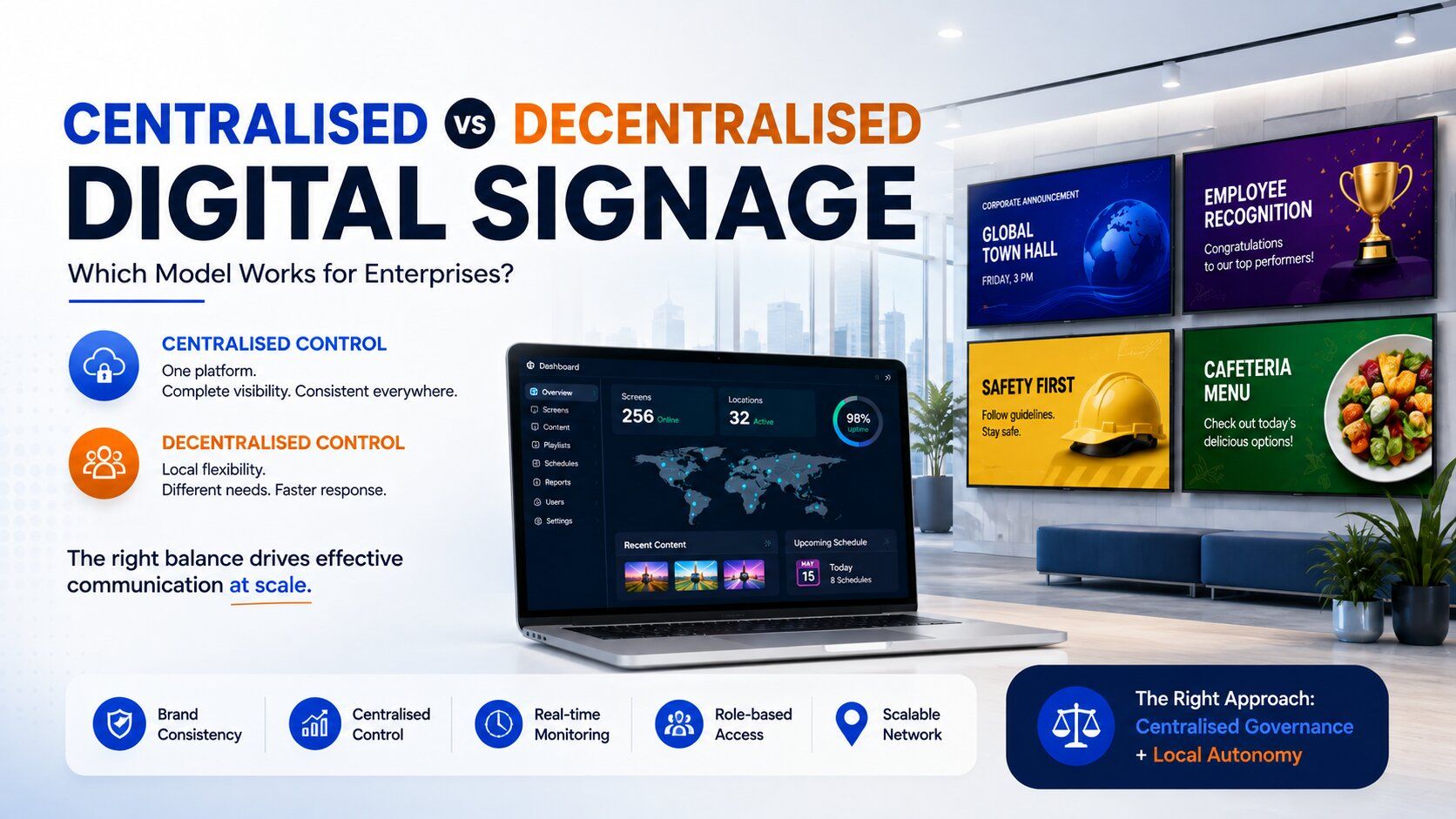
Digital Signage Software: Centralized vs Decentralized Models
A practical look at how enterprises can balance centralised control and local flexibility when managing digital signage across multiple offices, teams and locations.
Read More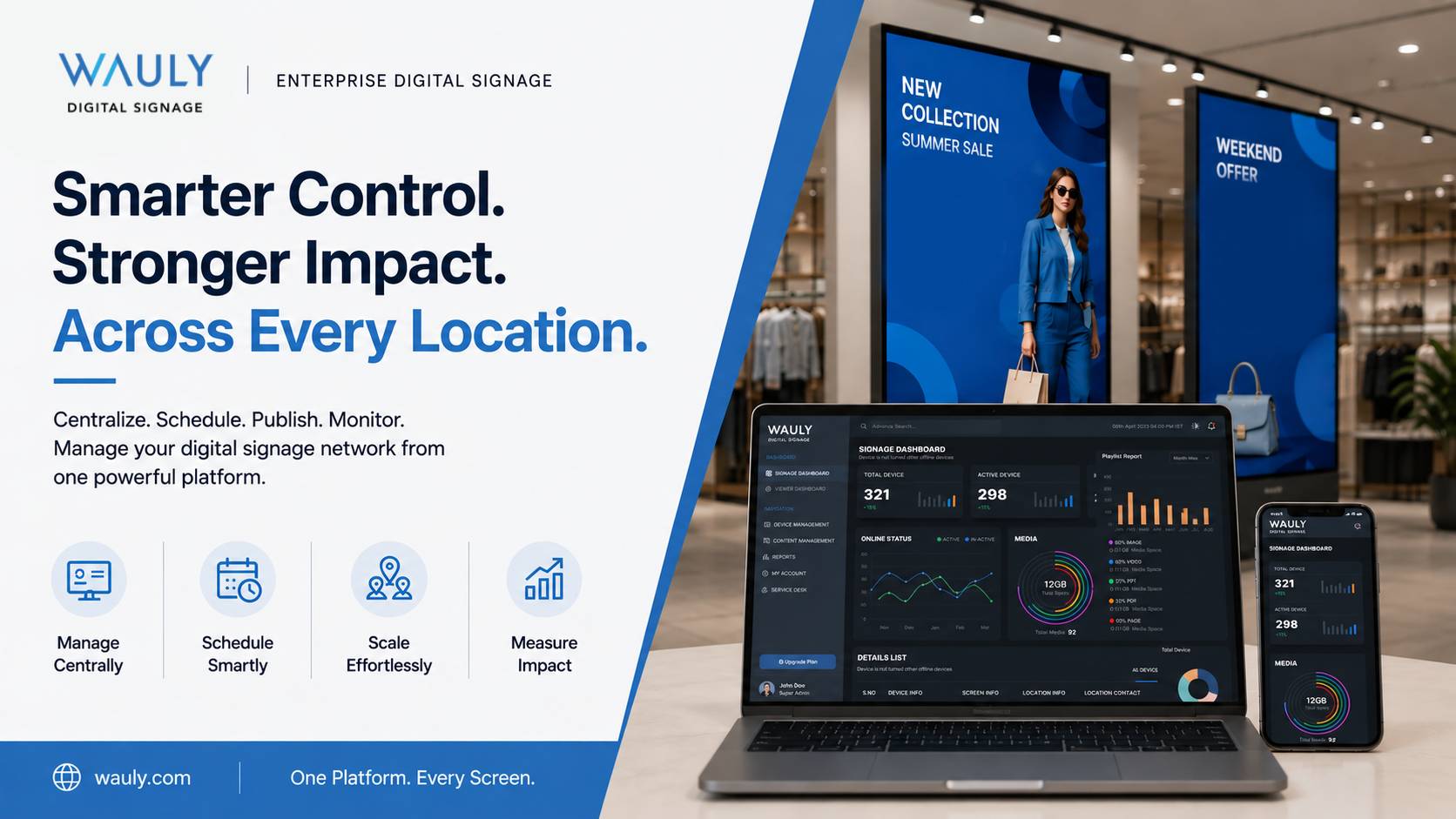
Digital Signage Software: Offline’s New Performance Marketing Benchmark
Explore how digital signage software is redefining performance for retail and other offline businesses by enabling centralized control, smart scheduling, consistent communication, and scalable screen management across every location.
Read More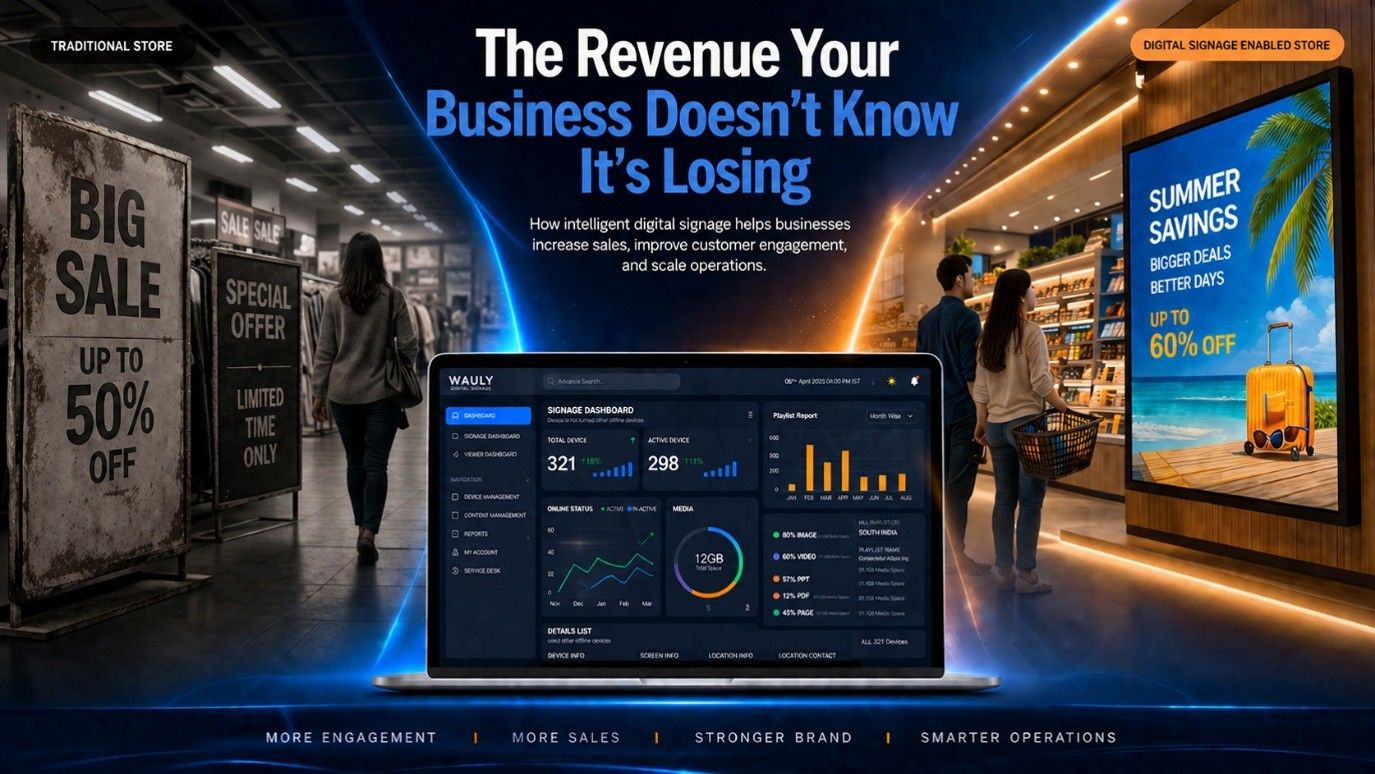
The Revenue Leak Most Businesses Never Measure: Why Digital Signage Is No Longer Optional
Every business invests to bring customers through the door, but many lose revenue once they're inside. Static posters, outdated displays, and manually managed screens fail to influence purchase decisions when they matter most. This blog explores how modern digital signage software helps businesses automate promotions, manage screens remotely, maintain brand consistency, and increase sales across multiple locations. Learn why the real value of digital signage lies not in the screens themselves, but in the software that powers them.
Read More
The Biggest Problem in Internal Communication Isn't Communication. It's Attention.
In today's workplace, information isn't rare, attention is. Organizations that continue measuring communication by the number of emails they send are solving yesterday's problem. The real challenge is ensuring important messages are actually seen, remembered, and acted upon.
Read More