




The Biggest Problem in Internal Communication Isn't Communication. It's Attention.



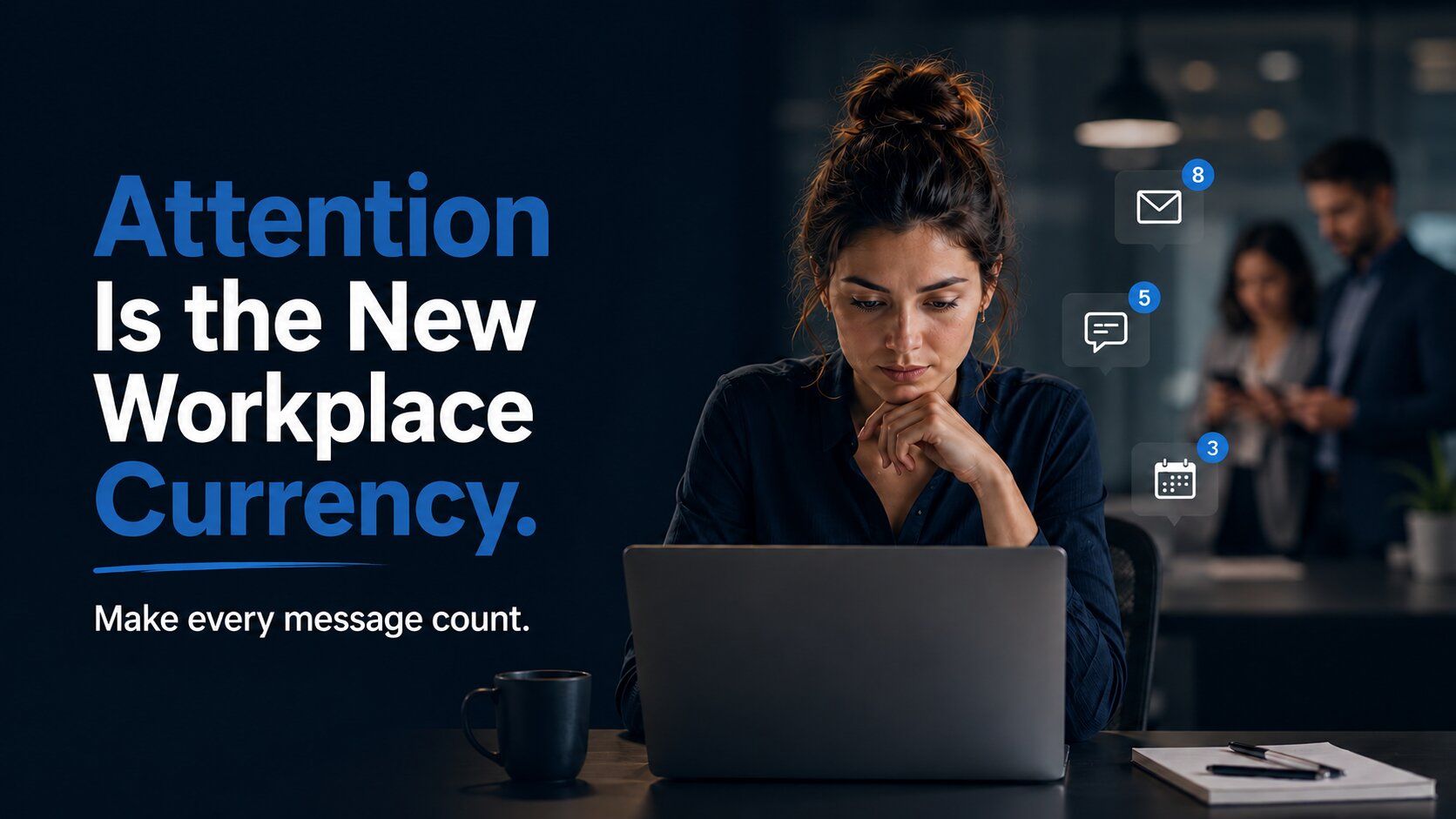
Every Organization Believes It Has a Communication Problem.
Walk into almost any organization, and you'll hear a familiar frustration. "Employees don't read our emails." "People still don't know about the new policy." "We announced this weeks ago. Why is everyone asking the same questions?"
Whether it's a corporate office, manufacturing plant, retail store, hospital, educational institution, or government department, the challenge is remarkably similar. HR spends hours preparing employee communication campaigns, IT shares maintenance alerts, leadership announces strategic initiatives, and operations teams communicate process updates. Yet weeks later, employees still ask questions that were supposedly answered.
The typical response is predictable: "We need to communicate more." So another email is sent. Another Microsoft Teams notification appears. Another newsletter is uploaded to the intranet. The message has been distributed but has it actually been communicated?
If you've ever heard an employee say, "Nobody informed me," despite multiple communications being sent, you've witnessed one of the biggest misconceptions in modern workplace communication. The problem isn't that organizations communicate too little. The problem is that important messages compete for attention in an environment where attention has become the workplace's scarcest resource. Most organizations invest heavily in creating communication but spend very little time asking a more important question:
Will employees actually notice it?
That single question separates organizations with effective internal communication strategies from those that constantly struggle with awareness, alignment, and employee engagement. Communication today isn't failing because people refuse to listen. It's failing because every message is competing against hundreds of others.
We Don't Live in an Information Economy Anymore. We Live in an Attention Economy
To understand why communication in the workplace has become increasingly difficult, we first need to understand how work itself has changed. A few decades ago, information was valuable because it was difficult to access. Today, the opposite is true. Employees are surrounded by information before they've even started their first task. A typical workday may include: • Emails arriving every few minutes • Microsoft Teams or Slack notifications • WhatsApp groups and mobile alerts • Calendar invitations • Project management updates • Dashboards and reports • Company newsletters • Back-to-back meetings At the same time, every department believes its communication deserves immediate attention. HR shares policy updates, IT communicates cybersecurity alerts, Finance sends compliance reminders, Operations announces process changes, Leadership outlines strategy, and Marketing celebrates company achievements. Individually, every message is important. Collectively, they compete against one another. The result is a workplace where employees aren't experiencing an information shortage. they're experiencing information overload. Nobel Prize-winning economist Herbert Simon predicted this challenge decades ago when he wrote: "A wealth of information creates a poverty of attention."
That simple observation has become the foundation of today's attention economy. When information becomes abundant, human attention automatically becomes scarce. Few places illustrate this better than the modern workplace.
Recent findings from Microsoft's Work Trend Index reinforce this reality. Employees now spend a significant portion of their workday in emails, meetings, and chats, leaving less uninterrupted time for focused work. As digital communication continues to grow, sending another message no longer guarantees that it will be noticed.
The challenge facing modern organizations is no longer: "How do we send information?" It's: "How do we make sure important information stands out?” Because successful employee communication is no longer measured by how many messages an organization sends. It's measured by how many messages employees actually remember.
Sending a Message Doesn't Mean It's Seen
One of the biggest misconceptions in internal communication is assuming that sending information is the same as communicating it. Many organizations measure success using distribution metrics: • Email sent ✓ • Newsletter published ✓ • Teams notification delivered ✓ • Policy uploaded ✓
From an organizational perspective, communication appears complete. Employees experience something very different. Every message must pass through a journey before it creates action:
Message Sent → Message Seen → Message Read → Message Understood → Message Remembered → Action Taken
Every step introduces friction.
An employee may receive an email but never open it. Another may read it between meetings and forget it minutes later. Frontline employees in manufacturing, retail, healthcare, or logistics may not even have immediate access to email during their shift.
Technically, the communication reached everyone. Practically, it reached very few. This is where many internal communication tools fall short. They're excellent at delivering information. They're far less effective at ensuring that information becomes visible. The success of communication depends on visibility, not simply on delivering the message. The organizations that communicate best don't necessarily send more messages. They make their most important messages impossible to ignore.
The Lesson Hidden Inside One of the World's Most Famous Advertising Campaigns
If attention has become the world's scarcest resource, perhaps the best place to understand it isn't inside an office, it's inside an airport. Walk through any major international airport and you'll be surrounded by thousands of competing messages. Airlines promote destinations, luxury brands showcase new collections, hotels advertise exclusive stays, and technology companies highlight their latest innovations. Every brand is competing for one thing: Your attention. Yet only a handful of campaigns become memorable.
One of the most celebrated examples is HSBC's "Different Points of View" campaign. The campaign paired bold visuals with minimal text, encouraging people to see the same situation through different cultural perspectives. It wasn't remembered because it communicated more than other advertisements. It was remembered because it captured attention before delivering its message. HSBC understood a principle that applies far beyond advertising: People don't notice information simply because it exists. They notice information that earns their attention.
Instead of overwhelming audiences with more content, the campaign relied on simplicity, strategic placement, and strong visual storytelling. It respected a fundamental truth of human behaviour that visibility comes before communication. Now imagine your workplace. • Replace airport advertisements with company emails. • Replace digital billboards with Microsoft Teams notifications. • Replace advertising campaigns with HR announcements. • Replace travellers with employees trying to complete their work. The environment changes, but the challenge remains the same. Every department is competing for the same limited attention.
That's why successful employee communication isn't about producing more information. It's about making important information impossible to overlook.
Why Employees Ignore Important Messages
When employees miss important announcements, organizations often assume they're disengaged or simply not paying attention. In reality, neuroscience tells a different story. The human brain wasn't designed to process every piece of information it encounters. Every second, it receives thousands of sensory inputs, notifications, conversations, and visual cues. Without an effective filtering system, even simple tasks would become overwhelming. To manage this, the brain continuously decides what deserves attention and what can safely be ignored, a process psychologists call selective attention. It's why you can focus on a conversation in a noisy café while tuning out everything around you. It's also why employees overlook another email notification. Not because they don't care. Because their brain has already decided it isn't immediately relevant. This isn't disengagement. It's how human attention naturally works.
Selective attention is only part of the challenge. Then comes cognitive overload. Every email requires a decision. Every notification interrupts concentration. Every meeting demands attention. By the middle of the day, employees have already made hundreds of decisions. To conserve mental energy, the brain automatically filters anything that doesn't appear immediately important. Ironically, critical workplace communication often becomes one of the first casualties. The problem isn't employee attitude. The problem is expecting overloaded minds to actively search for important information hidden inside crowded communication channels.
Communication Is Competing Against Work
One of the biggest misconceptions in workplace communication is believing employees are waiting for organizational updates. They're not. They're solving customer problems, serving clients, operating machinery, attending meetings, managing deadlines, supporting colleagues, and responding to urgent requests.
Communication isn't competing against silence. It's competing against work itself.
Every notification asks employees to pause what they're doing and shift their attention. Over time, that constant switching becomes mentally exhausting. This explains why increasing communication volume rarely improves employee engagement. More messages don't create more awareness. They simply create more competition for attention. Organizations often respond by sending even more emails, reminders, and announcements. But attention doesn't increase because information increases. It increases when communication becomes easier to notice, understand, and remember.
The Organizations That Win Attention, Design For Visibility.
Some of the world's most critical environments have already solved this challenge. • Hospitals don't rely solely on email during emergencies. • Airports don't expect passengers to constantly check their phones for gate changes. • Manufacturing facilities don't communicate safety hazards through lengthy PDF documents.
Instead, they design communication around visibility. Important information appears where people naturally look. Critical messages receive clear visual priority. The objective isn't simply to distribute information. It's to make missing important information extremely difficult. The same principle applies to internal communication. Communication isn't complete because information has been sent. It's complete when people actually notice it. Visibility isn't separate from communication. Visibility is what makes communication effective.
The Hidden Cost of Invisible Communication
When organizations think about communication costs, they usually focus on visible investments such as email platforms, collaboration software, newsletters, or employee communication software. These expenses are easy to measure because they appear on budgets. The real cost is far less obvious. It's the cost of communication that never achieves its purpose.
Every time an important message goes unnoticed, organizations pay for it in hidden ways. HR and IT teams answer the same questions repeatedly, managers repeat announcements in meetings, policy updates require multiple reminders, and new initiatives lose momentum before they're fully adopted.
The consequences affect the entire organization: • Lower employee engagement as people feel disconnected from organizational priorities. • Reduced compliance when critical updates are overlooked. • Increased workload for HR, IT, and managers due to repetitive queries. • Slower adoption of new initiatives and workplace changes. • Inconsistent execution because employees receive information at different times. These challenges don't arise because organizations failed to communicate. They arise because employees never truly noticed the communication. That's why visibility should be viewed as a business investment, not simply a communication improvement.
Most Internal Communication Strategies Focus On Distributing Instead of Visibility
Over the years, organizations have invested heavily in improving how they distribute information. They've adopted collaboration platforms, intranet portals, employee communication software, and automated email campaigns to make communication faster and more accessible. But speed doesn't guarantee effectiveness. A message delivered instantly still fails if nobody notices it. This is where many internal communication strategies unintentionally fall short. Organizations spend time asking: • Which platform should we use? • When should we send the email? • Should this be posted on the intranet? • How can we improve open rates?
Far fewer ask the question that matters most: Where are employees most likely to notice this information? That shift changes everything.
Traditional communication strategies optimize for distribution. Modern communication strategies optimize for visibility. Consider a workplace policy announcement. If it's shared only through email, employees may intend to read it later but forget amid dozens of other messages. Now imagine the same announcement displayed on digital screens in reception areas, cafeterias, lift lobbies, and meeting spaces throughout the week. The message hasn't changed. It’s visibility has. And that dramatically improves the chances that employees will notice, remember, and act. Successful communication in the workplace isn't about choosing one channel over another. It's about ensuring important information appears where employee attention already exists.
Visibility Is the Missing Layer in Workplace Communication
Most organizations already have the right information. The challenge isn't creating better messages. It's making those messages impossible to miss. Think about how employees naturally move through the workplace. They enter reception areas, wait for elevators, walk through production floors, gather in cafeterias, and spend time in meeting rooms and common spaces. These aren't just physical spaces. They're opportunities for communication.
Traditional channels require employees to stop what they're doing and actively search for information. Visible communication works differently. It brings important messages into employees' daily environment, allowing information to become part of the workplace experience instead of another task on a busy day. Employees no longer need to remember to check another application. The information finds them. That's why organizations are increasingly treating visibility as a core element of workplace communication, not an afterthought.
Why Digital Signage Is Becoming an Essential Internal Communication Tool
This is where digital signage changes the conversation. Often associated with advertising or customer-facing displays, modern workplace digital signage has evolved into one of the most effective internal communication tools available to organizations. Its purpose isn't to replace existing communication channels. It's to strengthen them. Each communication channel serves a different purpose: • Email provides detailed communication and documentation. • Microsoft Teams or Slack enables collaboration. • The intranet stores organizational knowledge. • Employee communication software manages campaigns. • Digital signage for internal communication creates visibility.
Together, these channels form a complete communication ecosystem.
Imagine employees arriving at work and immediately seeing today's priorities, leadership messages, safety reminders, production updates, employee recognition, upcoming events, and key announcements displayed throughout the workplace. No searching. No additional logins. No overflowing inboxes. Important information becomes part of the work environment instead of competing inside it. That's why organizations across manufacturing, healthcare, retail, banking, education, logistics, hospitality, and corporate offices are increasingly investing in digital signage for internal communication.
They're not replacing email. They're restoring visibility.
Digital Signage Doesn't Replace Communication. It Amplifies It.
One of the biggest misconceptions about workplace digital signage is that it replaces existing communication channels. In reality, it makes those channels more effective. A company announcement can still be shared through email. Supporting documents can remain on the intranet. Managers can discuss it during team meetings. But before employees engage with any of those channels, they first need to know the announcement exists.
That's where digital signage delivers the greatest value.
It creates awareness before action. By placing important messages where employees naturally spend their time, digital signage increases visibility, strengthens recall, and encourages employees to engage with the complete communication through the appropriate channel. In an attention economy, communication succeeds when people notice it first. Digital signage helps ensure they do.
The Future of Internal Communication Belongs to Organizations That Design for Attention
The workplace has changed dramatically. Employees now process more information in a single day than ever before. Emails, meetings, chats, dashboards, and notifications all compete for the same limited mental bandwidth. Yet many organizations continue using communication strategies built for a time when information was the scarce resource. Today, attention has become the scarce resource, and those strategies are no longer enough.
The organizations that succeed won't necessarily be those that communicate the most. They'll be the ones that communicate with the greatest visibility. Instead of asking, "How can we send more messages?" they'll begin asking, "How can we make our most important messages impossible to miss?" That shift changes everything. Because communication isn't successful when it's delivered. It's successful when employees notice it, understand it, remember it, and act on it. Everything before that is simply distribution.
Turning Attention Into Action
This is where digital signage for internal communication becomes more than another technology investment. It becomes a visibility strategy. By transforming everyday workplace spaces into communication touchpoints, digital signage bridges the gap between sending information and ensuring it's actually seen.
- Reception areas become welcome centres.
- Lift lobbies become information hubs.
- Cafeterias become spaces for recognition and engagement.
- Production floors become channels for operational updates and safety reminders.
- Meeting spaces reinforce priorities and organizational goals.
Instead of expecting employees to search for information, organizations bring information into their everyday routines. That's the difference between making information available and making it visible.
Final Thought
The next time an important workplace announcement receives little engagement, resist the temptation to blame the message or the employees. Ask a different question: Did the message ever truly have a chance to win your employees' attention?
In today's workplace, communication no longer competes with silence. It competes with overflowing inboxes, instant messages, meetings, dashboards, mobile notifications, and countless other distractions. Organizations that recognize this reality will rethink how they approach internal communication, employee communication, and workplace communication. They'll stop measuring success by the number of emails sent or announcements published and start measuring it by what employees actually notice, remember, and act upon. Because in the attention economy, communication isn't the competitive advantage. Visibility is.
Organizations that make their most important messages visible won't just communicate better. They'll build stronger cultures, more informed employees, higher engagement, and workplaces where communication finally achieves what it was meant to do.
Recent blogs

Successfully transition from static displays to digital signage
If you need a reason to transition from static to digital signage, here are three
Read MoreIncreasing consumer purchases and reducing marketing costs
Numbers don’t lie. Studies suggest that 76% of buyers claim to enter.. store for the first time ever because of signage
Read MoreWhy digital signage solutions are best for restaurants
As a restaurateur, you would want your eatery to be people’s first preference.
Read MoreMost Recent blogs
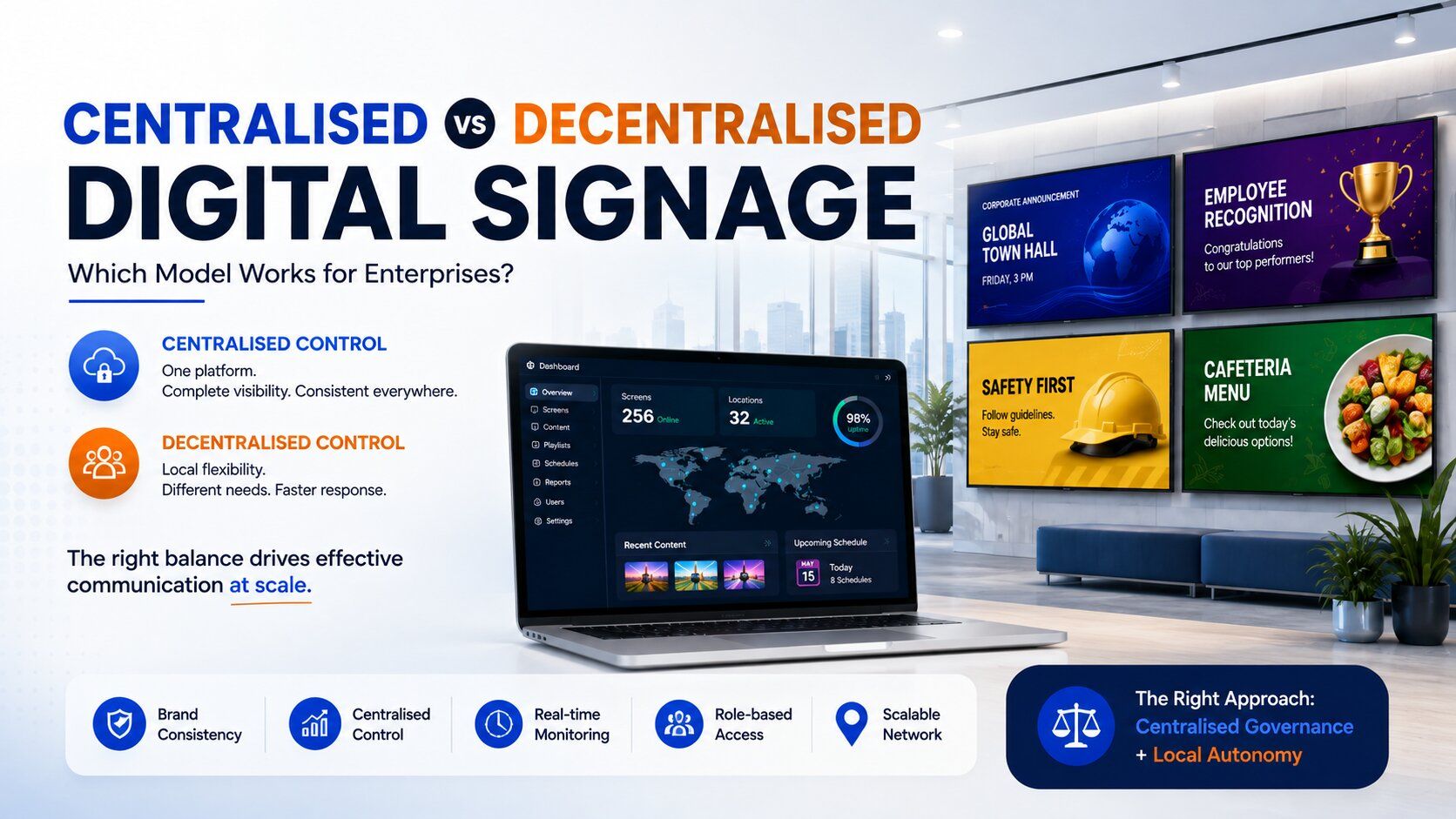
Digital Signage Software: Centralized vs Decentralized Models
A practical look at how enterprises can balance centralised control and local flexibility when managing digital signage across multiple offices, teams and locations.
Read More
Digital Signage Software: Offline’s New Performance Marketing Benchmark
Explore how digital signage software is redefining performance for retail and other offline businesses by enabling centralized control, smart scheduling, consistent communication, and scalable screen management across every location.
Read More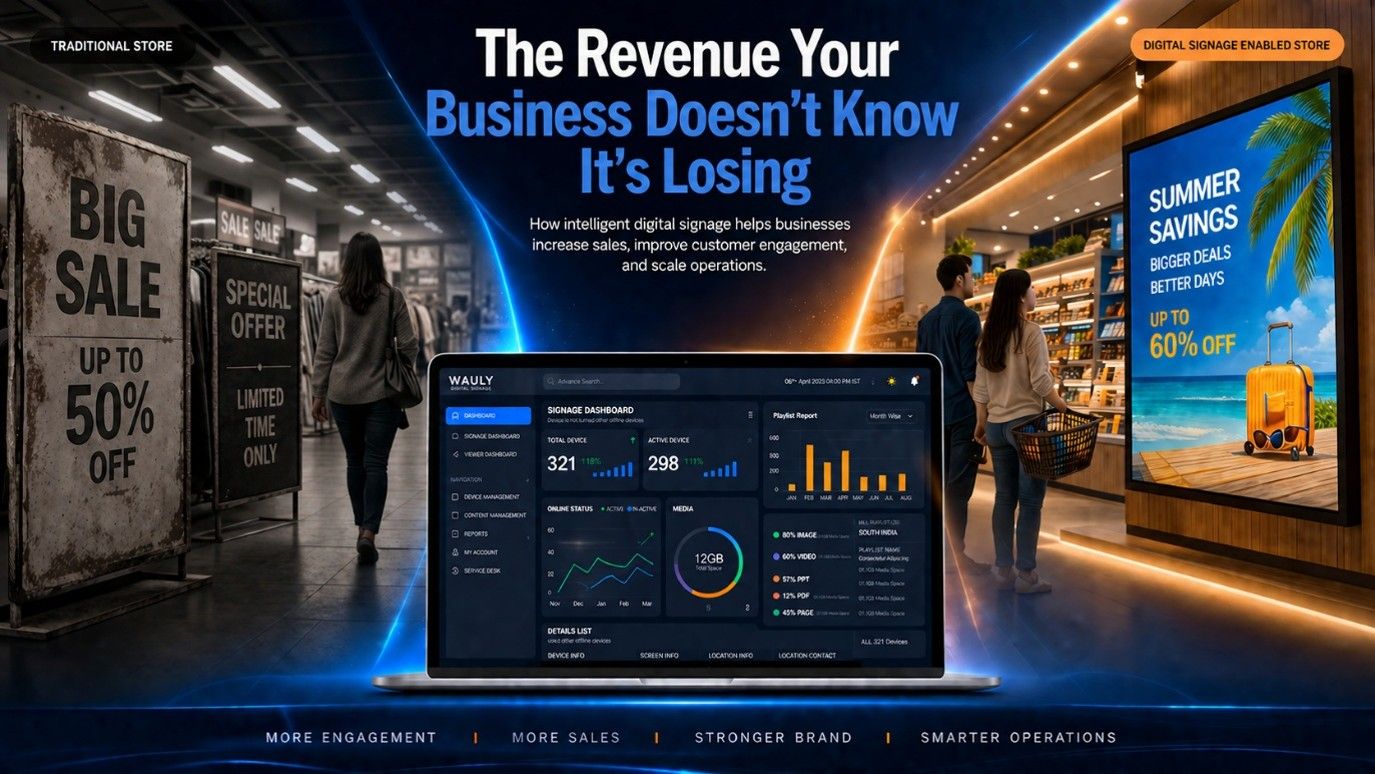
The Revenue Leak Most Businesses Never Measure: Why Digital Signage Is No Longer Optional
Every business invests to bring customers through the door, but many lose revenue once they're inside. Static posters, outdated displays, and manually managed screens fail to influence purchase decisions when they matter most. This blog explores how modern digital signage software helps businesses automate promotions, manage screens remotely, maintain brand consistency, and increase sales across multiple locations. Learn why the real value of digital signage lies not in the screens themselves, but in the software that powers them.
Read More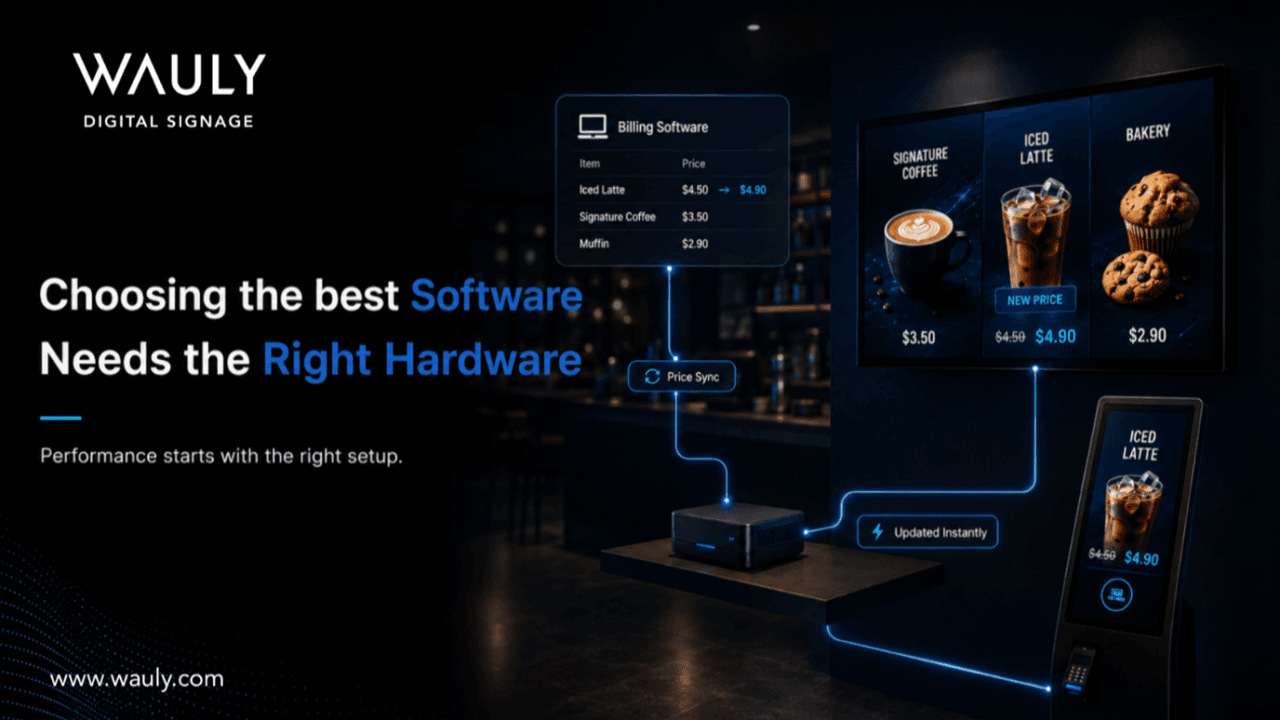
Why Choosing the Right Digital Signage Hardware Matters for QSR Businesses.
Why selecting the right digital signage hardware is just as important as choosing the right software for QSR businesses. It explores how factors such as heat, steam, humidity, operating hours, and outlet type influence display performance, and how Wauly helps brands choose the right hardware and software combination for reliable, centrally managed digital signage across every location.
Read More
6 Innovative Uses for Digital Display Boards
Digital display boards offer real-time, eye-catching content that boosts foot traffic and engagement—far more effectively than outdated static signs.
Read More